Subscribe to blog updates via email »
Design for Hackers: THE BOOK!
Last week, I signed a contract to publish Design for Hackers: Reverse-Engineering Beauty with John Wiley & Sons. I still have plenty of work left to get this book onto shelves – and to exist at all – but I’m extremely excited about it, and wanted to share the news with everyone, especially visitors coming from Hacker News (more on that in a bit).

What is Design for Hackers?
My goal for Design for Hackers is to help Software Developers and Entrepreneurs (Hackers) – who are interested in design – see the world the way a designer does. Hackers are used to teaching themselves whatever is necessary to achieve their vision; and for most things this is relatively straightforward. If they are learning to program, and come across an error, they can do a quick Google search. If they want to know how to do their own bookkeeping, they can learn about this easily with a book or by looking around on the web. Unfortunately, there’s no quick fix found when you Google “my design sucks.”
WANT TO WRITE A BOOK?
Download your FREE copy of How to Write a Book »
(for a limited time)
The problem with most advice given by designers is that it usually consists of rules (“use no more than two fonts”) that are often conflicting and easy to forget. Naturally, the decisions made by designers are difficult to put into words, and many designers are better with images than words. Rather than teaching you to fish, they give you a fish. When you’re still confused, they may shrug their virtual shoulders and explain that its just their natural talent that makes them able to design. This is usually true, but I believe natural talent is not a requirement for understanding design – especially not for naturally curious people who can teach themselves nearly anything, given the right information.
There are some very consistent principles behind what makes a design visually compelling, and these principles are as important on the screen of your iPad as they were on the streets of ancient Rome. My goal is to weave these principles into your brain using examples from today, as well as from the history of art, architecture, and design. I will tell stories and present examples that will infect your brain, make you look smart when you retell them at parties, and change the way you see the world around you. I’ve been telling my friends, “it’s like Freakonomics, for Design.”
How did this book deal come about?
The way this book deal came about just affirms my beliefs about Inviting Serendipity. I started with a very strong desire to present at SXSW. I love the conference, I love to share knowledge, and I really wanted to contribute. But, I wasn’t sure what I had to offer. I brainstormed for a couple of weeks, bouncing ideas off of friends, amongst them that of Being Yourself for a Living. Nothing really stuck.
Then I remembered the talk that a friend encouraged me to give at BarCamp Chicago a couple of years ago, Design for the Coder’s Mind: Reverse-Engineering Visual Design. I at least had something to start with, but the title needed more pop. Since I also love the community on Hacker News, and that community overlaps with that of SXSW, I settled on Design for Hackers.
But 30% of SXSW’s panel selection process is based upon votes on their Panel Picker; and, unfortunately, I am not famous enough to get a considerable amount of votes. Fortunately, I had previously had some luck in getting some articles on the front page of Hacker News, so I set out to do that again, with the hopes of directing the community to vote on the Panel Picker.
Hacking the System
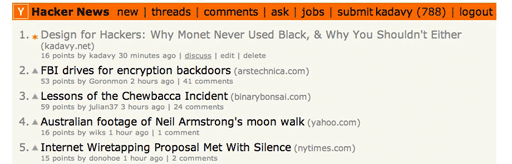
The plan was to write sample content related to my topic and get on the front page of Hacker News – which isn’t necessarily easy to do at will. So, I spent a couple of weeks drafting, refining, and crafting Design for Hackers: Why You Don’t Use Garamond on the Web. The topic felt great to write about, and the words came easily, tickling my brain on the way to my fingertips; but just when I thought the post was good, I would iterate again, digging as deeply into the details as possible. The goal was to to make it so brain melting that the HN community couldn’t help but love it.
And it worked! The article made it to #1 and brought in over 20,000 views within a couple of days. Unfortunately, I had no way of knowing how many votes it was bringing in on the Panel Picker.
Serendipity Knocks
Then I got an email from Chris Webb of Wiley & Sons, saying he loved the idea, and wondered if I had thought about writing a book about it.
I said I most certainly had. Writing a book has been a nebulous sort of “wouldn’t that be nice” goal; but I wasn’t sure about what I would write. I had thought of writing about Being Yourself for A Living, but I didn’t have much with which to work. Since Goals are Bananas, I figured I would just keep swinging through the trees and see what happened.
Convergence
But this idea really made sense for me to write about at this point – making it The Perfect Salad. My childhood obsession with drawing, which grew into an adulthood obession with design and typography, which melded with a fascination for the internet and knowledge sharing; the itch I scratched with that first post on my blog, which brought me to Silicon Valley – all were melding with my experiences of studying typography in Rome and working at an architecture firm, to create what I really felt like was a unique point of view. This was Being Myself for a Living.
So it felt like the right idea, but author friends of mine warned me what a huge undertaking – with little immediate reward – writing a book is. After a few months of weighing all of the considerations, and getting the right agreement together, it still felt like the right thing for me to do at this point. It might not make me rich, but the satisfaction of having people tell me “[I] blew [their] mind” is enough.
What about that original goal?
The funny thing is, after two rounds of selections, my panel hasn’t yet been accepted to SXSW – maybe the book deal will help. UPDATE: SXSW has accepted me into their book reading program! I’ll be presenting about my book on Monday, March 14th. Sign up for the email list for further updates. See you at SXSW!
So, here we go
Design for Hackers: Reverse-Engineering Beauty will be a design book for developers and programmers, and is due out in September of 2011, in all major book outlets: Amazon, Barnes & Noble, Borders, etc..
Be a part of it: sign up for updates
To start off the book writing process, I want to start getting closer with my most loyal readers. So, I am starting an email newsletter, where I’ll share with you some of the techniques I developed to turn my passion for designing and writing into a book deal. I’ll be testing out some of the content I’m working on for the book – seeking your feedback; but I’ll also be sharing some of my most closely-held secrets I’ve used to get this book deal. I plan to send out about an email a month, and have already started drafting some sample content. Find out:
- How 6 of my last 9 blog posts made it to the front page of Hacker News, and what my writing style has to do with good design.
- How I turned my blog into a passive revenue stream (including over $20,000 in one year from *one* blog post), freeing myself to follow my creativity all the way to a book deal.
- How I have turned my blog into a virtual R&D department, providing me valuable data to tell me what “spin-off” sites to develop for more passive revenue.
Since the book is Design for Hackers, the newsletter will of course be filled with more brain-liquefying observations on design-related things I’ve seen around the web, and sneak previews of content that won’t be seen otherwise until the book launches in September 2011. Some things I’m kicking around for the book:
- Why designers should stop whining about crowd-sourcing, and cash in on the revolution
- Why even the ugliest “lost dog” poster is beautiful
- Why SEO is Design
I’ll also be asking for your help in developing content for the book, asking questions about what great design you’ve been seeing, and what challenges you face as you learn about design.
(YOU) Sign up for the email list here. (NOW!)
I’ll, of course, still be exploring the topic right here at kadavy.net.
Pardon me now, as I had better get writing.