
Remember last week when I told you that Google Webmaster Tools was reporting faster page load time? Well, I found another interesting metric, under Diagnostics < Crawl stats. It looks like the Googlebot is also crawling my site much faster:
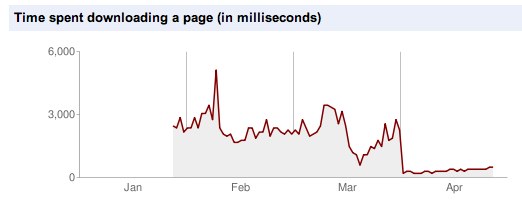
Google did say that their new speed standards will only affect about 1% of searches; but this graph makes me believe that portion will increase. If a site can be crawled faster – and requires less resources (clarification: time & money, not CPU) to index, doesn’t it stand to reason that it will be rewarded with higher search rankings? Additionally, I’ve heard from a number of people that they’ve seen higher CTR on ads when they improved performance – since so many sites have Google AdSense, Google will make more money by directing users to these faster sites.

Cheaper indexing, higher revenues on visits = speed is good.
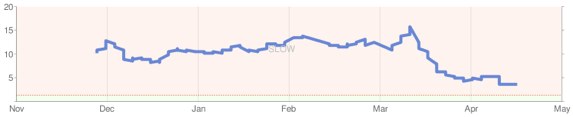
Here’s that beautiful page load time graph from last week’s WordPress performance optimization post again.
- - -You should follow me on Twitter here.


steve said,
April 28, 2010 @ 12:50 pm
Very nice spot, thank you. Time to kick a few bits to optimise.
Amit Gupta said,
April 28, 2010 @ 2:52 pm
I’m curious David — how quickly did you see Google webmaster tools reflect your page load improvements?
We’ve done some optimizations recently (it’s been a few weeks) but haven’t seen an impact on our graph, and webmaster tools makes the same suggestions for page speed improvements it did before (many of which we’ve already implemented.)
Amit
kadavy said,
April 28, 2010 @ 3:15 pm
Hey Amit – I actually saw results pretty quickly. You can see on that Website Optimizer graph that I put up that the reflection of the changes was somewhat gradual, but I attribute that to some DNS issues that I had, and some tweaking that I was doing.
It definitely seems strange that you still haven’t seen results, and I’m assuming that your own benchmarks are showing an improvement.
Brian Armstrong said,
April 28, 2010 @ 3:23 pm
This is great info. Just want to point out that because a page loads faster doesn’t mean it uses less resources to index. Bandwidth, CPU, and memory would all be the same either way. The crawling process would just be waiting for the page to return longer – so the cpu would be working on other processes while it waited.
It’s likely Google gives a ranking bonus to faster sites, but this is probably just because humans prefer fast sites. Good article though! Didn’t mean to be nit picky
kadavy said,
April 28, 2010 @ 3:34 pm
Hey Brian – by “resources” I mean time & money (I’ve had to explain this a couple of times now, so I updated the post for clarification).
Ultimately, Google can crawl more of a fast site with their resources (time & money), and when users get there, Google makes more money because of higher CTR on the ads. But yeah, user experience fits into that, too.
idont said,
April 28, 2010 @ 3:51 pm
I did not noticed any difference on my stats.
I usually have good figures which make few room for optimisation in absolute value:
- Time spent downloading a page (in milliseconds): 203 (average)
- On average, pages in your site take 1.0 seconds to load (updated on Apr 26, 2010). This is faster than 90% of sites. [...]