
Newer Post
« Designing with White Space: Why 1+1=3

Subscribe Right Now!

 RSS Add to Google Reader or Homepage

Older Post
Design for Hackers: THE BOOK! »

Why You Hate Comic Sans

OMFG I Wrote a Book!

Design for Hackers: Reverse-Engineering Beauty (Wiley & Sons, September 2011) will help you see like a designer does.

Everyone loves to hate Comic Sans. The child-like handwriting font is so infamous, there is a movement to try to ban it. Mention its name to the common layman (aside from a preschool teacher), and you will likely get a chuckle, mention it to a trained designer, and you’ll get a look of disgust. But what exactly makes Comic Sans so horrible?


I recently gave a talk at IgniteChicago – with less detail than what follows – about just why it is that Comic Sans is so hated:

Comic Sans vs. Helvetica

To illustrate the poor fundamentals of Comic Sans, I will compare it to Helvetica, which is such a beloved font, that there’s a movie – about typography – named Helvetica.

First of all, I should acknowledge that comparing these fonts is a bit apples to oranges (which are both fruits, mind you), in that they both convey completely different moods: Helvetica looks strong and serious, and Comic Sans is usually used in situations where one wants to look playful and casual.

Both Have Unmodulated Strokes
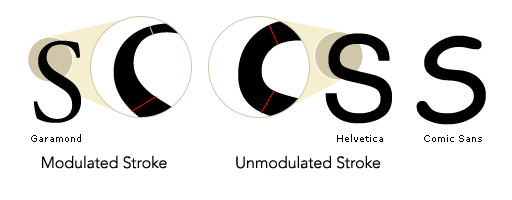
Comic Sans and Helvetica both have unmodulated strokes, unlike Garamond.

But they have their similarities as well. They both have a relatively unmodulated stroke, meaning that the thickness of the strokes on the fonts don’t change throughout the stroke. This sample shows how Helvetica’s form differs from that of Garamond, which has a modulated stroke. Comic Sans also has an unmodulated stroke.
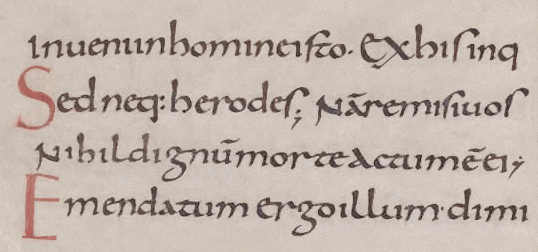
Scribed lettering had modulated strokes - a result of drawing tools - which later influenced the first printed fonts.

This modulation is a result of Garamond’s form being derived from that of scribed letters. Before printing was available in the West, scribes lettered Bibles beautifully and patiently by hand, using a flat-tipped pen, held at a fixed angle, which influenced the form of those letters – resulting in a modulated stroke. As printing was developed, the letters created mimiced scribed letters, and – while they eventually developed their own forms – printed letterforms almost exclusively had modulated strokes until sans-serif type was popularized in the early 1800′s. The forms of most sans-serif fonts are not influenced by drawing tools.

Helvetica Manages Weight Better
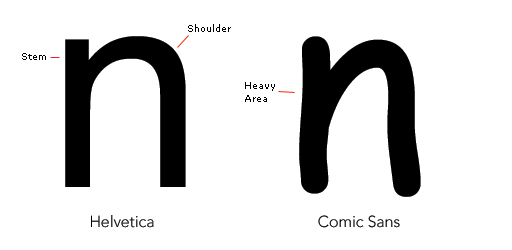
Helvetica manages the visual weight of its letterforms more delicately than does Comic Sans.

Though the strokes of Helvetica’s letterforms are unmodulated, some adjustments are made to improve its legibility. For example, notice how the stroke on Helvetica gets thinner where the shoulder meets the stem on this letter n. This helps to give the letter a more even visual weight. Notice how Comic Sans is not this way. If you squint your eyes, you’ll notice that there is a disproportionately heavy area where these strokes meet on Comic Sans, while Helvetica’s weight is more evenly distributed. The ironic thing about this distinction is that Comic Sans is actually influenced from a drawing tool: a round, felt-tipped pen or marker; but, the stroke of this tool is unmodulated. Meanwhile, the letterforms of Helvetica are rationalized from predecessors, without apparent influence of a drawing tool.

This mismanagement of visual weight is the main issue that makes reading Comic Sans an unpleasant experience. Evenness of weight, or “texture” is important to the legibility and readability of typography. Letters or blocks of text that are free from disproportionately light or heavy spots allow the letterforms themselves to shine through and be read easily.
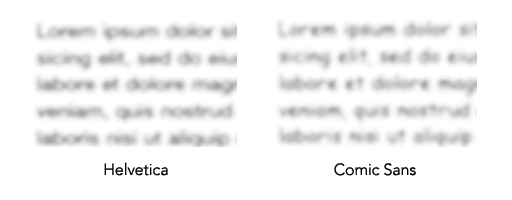
Helvetica yields a more even texture in body copy than does Comic Sans.

This example shows how a block of text set in Helvetica differs in texture from a block of text set in Comic Sans. I’ve blurred both blocks of text and bumped up the contrast so we can all collectively experience an objective form of squinting – to identify areas that are excessively light or dark.

First, notice the general variation of lightness and darkness in the lines of type. The Helvetica is a more uniform grey, while the Comic Sans varies widely, with some very dark spots scattered throughout the body of text. The most obvious anomolies are the letters “e” and “t,” the former of which appears like a blood stain a number of times in the example, and the latter which sticks out like a dead tree.
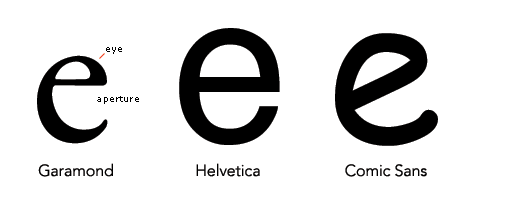
The stroke modulation of Garamond allows for it to have a small eye & large aperture.

The Comic Sans “e” appears more dark than the other letters because it’s overall visual weight is mismanaged. When compared to Garamond and Helvetica, we can get some idea of why. Garamond’s “e” features a very large aperture, and small eye, but its stroke modulation keeps it balanced. The extreme heaviness of the stroke towards the bottom left of the “e” is balanced out by the large aperture, and the tiny eye is balanced out by the very thin bar that closes out the eye. Helvetica maintains balance by compensating for its absence of stroke modulation by having a larger eye and a smaller aperture. Comic Sans, however, by virtue of its handwriting-based style, has a tilted – incidentally “Venetian” – eye to its “e” giving it both a small eye, and a large aperture. Since there is no stroke modulation to Comic Sans, it can’t compensate for this lack of balance and thus utterly fails.

Comic Sans Has Poor Letterfit

But poor management of visual weight within the letterforms themselves isn’t the only characteristic that makes Comic Sans uneven in body text. The “letterfit” – or consideration given to the letterforms to allow them to be set together in an even manner – of Comic Sans is very poor. The letterfit of Helvetica allows for it to inherently have decent kerning tables. Kerning is the distance between two letters, and good fonts have parameters set for just about every letter combination (or “kerning tables”) in which the font may eventually be set; but if the letters themselves aren’t designed with consideration given to how the letters will relate to one another, then producing good kerning tables is impossible.
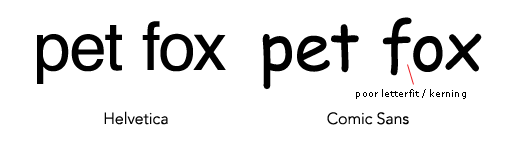
The poor letterfit of Comic Sans makes it nearly impossible for it to be kerned properly.

You can see that Comic Sans has an awkward gap between the “f” and the “o,” but this pairing can’t simply be more tightly kerned, as it would create an area of tension – from too close proximity – between the crossbar of the “f” and the “o.” You can see similar problems throughout the font, but this is one of the better examples. This problem could have been avoided if the leading portion of the crossbar of the “f” weren’t so long (notice that it is shorter on Helvetica). One way to compensate for these poor pairings would be to space the letters out a bit on the whole, to allow for relatively tighter pairings for problem areas such as I’ve described; but, this isn’t feasible in most computer applications, and it would do little to make up for the other blunders of Comic Sans.

So, the typographic fundamentals of Comic Sans are very poor as used in high-resolution situations, but Comic Sans was never intended to be used in this manner, and that is part of why its considered such a bad font.

Comic Sans isn’t Used as Intended
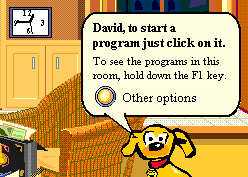
Comic Sans was designed to be used in these talk bubbles in Microsoft Bob.

Comic Sans was originally designed to be used in the talk bubbles of a program called Microsoft Bob. The font wasn’t completed in time to actually make it into the program, but it lived on to eventually ship with Windows 95; and that’s when the font really got ugly.

Once the font was in the hands of Windows 95 users, there was no telling how people would use it. Now, it was going to be printed out on bake sale flyers, birthday party invitations, and even business cards. But remember, this font was designed to be used on-screen, and in 1994, when the font was designed, most computers for personal use – and Windows 95 – didn’t have anti-aliasing.
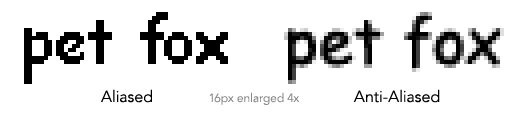
Comic Sans was originally designed to be displayed aliased.

Anti-aliasing is the technology that makes fonts looks smooth on-screen. Without ant-aliasing, fonts look jagged – as if they were made of LEGOS®. This isn’t the end of the world, as long as the font is designed accordingly. Notice how much better the “e” of Comic Sans distributes its visual weight when aliased.
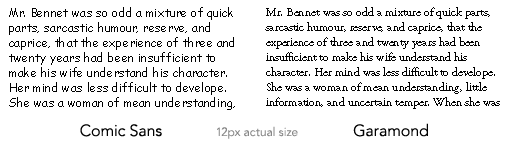
When aliased at 12px, Comic Sans is more readable than Garamond.

In fact, when compared to Garamond, which wasn’t originally designed for the screen, Comic Sans fares quite well in terms of readability.

Where the Hate Comes From: The Wrong Place at the Wrong Time

So, the story of Comic Sans is not that of a really terrible font, but rather of a mediocre font, used incorrectly on a massive scale. Windows 95 was the first operating system to really hit it big. Just as computers were starting to pop up in nearly every home in America, Windows 95 was finding itself installed on all of those computers, and with it, the font Comic Sans. So now, nearly every man, woman, child, and bake sale organizer find themselves armed with publishing power unlike civilization had ever seen; and few of them really had any design sense.

Comic Sans Rode a Wave: Desktop Publishing

It used to be that if you lost your kitten, and wanted to make a poster, probably the most efficient way to make a flyer would be to draw one up with magic marker, cut out a picture of the cat, and go down to the nearest supermarket to make copies of it at 15 cents apiece. Then, you would post them up in your neighborhood; and – like a caveman – you would pick up a phone, call the newspaper, and place an ad to help find your kitten.

But now that you had Windows 95, a personal computer, and a printer, you could use Word to make your lost kitten poster, and print it out at home. And, wow! You could use any font you wanted. What’s that? You don’t know anything about fonts? Of course not, because you’ve never had this power before. So, guess what font makes you think about your lost kitten?

This is a monumental moment in history – right up there with the invention of printing – for common people to suddenly have the power to typeset and print documents. No big deal for awhile: some people got to enjoy making their own Christmas cards, birthday party invitations, etc. for awhile, and the small audiences of their families and coworkers suddenly had to put up with some ugly, clip art riddled Christmas cards.

But then, gradually, over the next 10 years or so, the internet got more and more popular. Now, that publishing power got even stronger: instead of flyers posted in break rooms, Comic Sans was showing up on websites, and even as the default font for many people’s emails. Now, any one person could write a message that could potentially be read by millions, in Comic Sans. This actually happened when Cleveland Caveliers owner, Dan Gilbert wrote a letter regarding the dramatic departure of LeBron James, in Comic Sans – resulting in a media storm over the poor font choice.
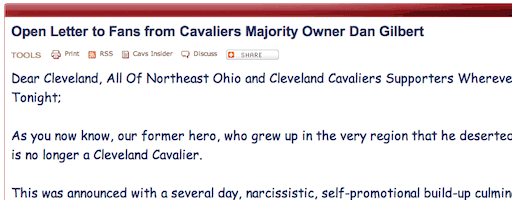
Dan Gilbert's usage of Comic Sans was the height of the font's infamy.

The Rise of the Graphic Design Degree, & The Formation of an Army of Haters

But where did all of this hatred come from? Well, while grandmas around the world were printing birthday invitations in Comic Sans, the field of Commercial Art (now known as “Graphic Design”) was enjoying the revolutionary typesetting power that the Macintosh provided. No longer did they have to blindly “spec” out type, not knowing what the final result would look like until their work got back from the typesetter. This made the production of high quality print design much cheaper, and much more viable for businesses to spend money on. So, with the increased demand for Graphic Design services, Design schools started churning out graduates at an unprecedented pace. Who doesn’t want to just sit and draw stuff for a living, right?

At this point – the late 90′s – all of these young people are suddenly seeing the world through new eyes. Having been through it myself, words cannot describe the jarring experience of Pandora’s box being opened up to reveal that 95% of every designed thing you see is ugly. Terrible font choices, poor kerning, haphazard color choices, and stupid concepts suddenly assault your eyes once you learn about design principles, color theory, typography, and concept development. A large portion of conversations between myself and other self-righteous design students were – and still are – about how terribly designed everything is: campus wayfinding signage, the t-shirt for the latest toga party, and yes, lost kitten posters.

But most of these design students were – and still are – blind to what a monumental, mammoth, incredible, revolutionary, huge thing was occurring. Their grandmother could typeset and print out as many lost kitten posters as she wanted. She can even make a website about her kitten, and someone in Tanzania can read about it (this is probably only remarkable to you if you don’t live in Tanzania). This makes Gutenberg’s 42-line Bible look like the non-self-inflating Whoopie cushion!

The Clash of Knowledge & Ignorance

Eventually, regular people got more familiar with this publishing power, desktop publishing applications – like Microsoft Publisher – became more widely available, and more people started to get the hang of publishing on their own. This really started to encroach on the territory of these fresh design graduates, many of whom were finding being a Graphic Designer to really suck: a client may have her nephew design a brochure, and hire you to clean it up, or worse yet – take a stab at it herself.

Meanwhile – this is the last decade or so – the same invention that made Graphic Design easier was making it way harder: print was dying, and the web was growing. Now, clients are trying to direct designers themselves, and the designers need to learn how to code web pages just to stay relevant. This doesn’t sit well with most designers.

So, you see, Comic Sans is an archetypal enemy of the Graphic Designer. Its not only an unattractive font, but it also represents the invisible, evil force that is making the “print” designer less and less relevant. A natural reaction to being threatened is violence, and the hatred for Comic Sans is arguably violent.

A Well-Designed Future

Comic Sans is at the disposal of nearly everyone with a computer; but that doesn’t mean that we will always have to be subject to its awkward forms. The spread of Comic Sans – a pretty bad font – is the result of the spread of an inarguably good technology. Just as the advent of movable type eventually lead to a spread of literacy, the advent of personal publishing should lead to the spread of design literacy; and with it, a populace too informed to stoop to using Comic Sans.

——-

I’m hoping to help with the spread of this design literacy – starting with software developers – with my book, Design for Hackers. If you’re interested in learning more and getting a few email updates for me, sign up for the email list.

Also, I’ll be doing a reading from my book at SXSW Interactive, if you’ll be around.

Until then, you can follow me on Twitter here, if you’re into that.

Tags: , ,

Was it good for you?

Subscribe (NOW!). We'll do it again soon :)

RSS Add to Google Reader or Homepage Subscribe in Bloglines

Wanna see the rest
of this puppy?
Buy me a cup of tea »

puppy

93 times, people have spoken up Say something! »

  1. katie licht said,

    January 25, 2011 @ 10:49 am

    i feel like I should stand up and start a slow clap. this is great, dave.

  2. Jason said,

    January 25, 2011 @ 11:06 am

    Ok, now you’ve thought us about comic sans. Now let me teach you something – that microphone’s being used to amplify your voice, there is really no need to rOAR in to the damn thing.

  3. b-rad said,

    January 25, 2011 @ 11:16 am

    Muy fantastico senor Kadavy! Can’t wait to see that book! Pumped!

  4. Per Almered said,

    January 25, 2011 @ 11:21 am

    Clap clap clappity clap! Brilliant article, well thought-out, excellent examples and just perfect execution. Thanks a lot for the best read in many weeks!

  5. Jeff said,

    January 25, 2011 @ 11:25 am

    Towards the end, it should read “populace” and not “populous”.

  6. Jeff said,

    January 25, 2011 @ 11:27 am

    Not to be overly picky, but since you are writing about type design, you really need to be using em dashes (—) and not hyphens (-). Also, the dash is not surrounded by spaces.

  7. Marsh Ray said,

    January 25, 2011 @ 11:41 am

    No way, Comic Sans is awesome!

    What better way to distance yourself from the font snobs who elevate form above substance? To ensure your ideas are not taken too seriously or extended too far beyond their domain of applicability?

    I’m giving a presentation this week, but I’m on Linux and don’t have Comic Sans. Can you suggest an alternate font available in OpenOffice Presentation with which I may achieve a similar effect?

  8. John said,

    January 25, 2011 @ 11:41 am

    Which is correct as the plural of LEGO: ‘Lego’ or ‘Legos’? Neither, actually. The word ‘LEGO’, when used as a noun, should only refer to the company that makes the product. Otherwise ‘LEGO’ is supposed to be used as an adjective. Thus, when referring to the pieces, neither ‘lego’ nor ‘legos’ is correct… rather one should say: ‘LEGO bricks’ or ‘LEGO pieces’ or whatever (using LEGO as an adjective — and one should really capitalize all of the letters, and put the little ‘circle-R’ symbol after it (®)). This is all a matter of protecting the trademark of ‘LEGO’ for the company (using it otherwise degenerates the strength of the trademark). This is not to say that I use the word correctly 100% of the time… but that’s the answer to the question (it’s always fun/painful to read the near-flame-wars that start at slashdot.org over this topic… and generally, both sides are wrong).

  9. eric said,

    January 25, 2011 @ 11:45 am

    that was very funny david – and i learned something too.

  10. David Kadavy said,

    January 25, 2011 @ 12:37 pm

    @Jeff (the one who wrote about the em dashes). I’m actually using an en dash surrounded by spaces, at the recommendation of Robert Bringhurst’s Elements of Typographic Style. It’s my feeling that an em dash without spaces is disruptive to an even texture of body copy, and that an en dash surrounded by spaces is less jarring. More on this in the book.

    Thanks so much for caring enough to comment.

  11. jess said,

    January 25, 2011 @ 2:46 pm

    Great article David. And timely as well; I’m a hacker currently working on a redesign for my blog + dev shop, and have been studying typography and font selection. I have a pretty intuitive grasp of many elements of design (color palettes, whitespace, layout, etc.), but typography is a tough one. Especially with all of the choices available with @font-face, font selection is just one big complicated mystery. I’m sure my font choices are saying something, but I’m not really sure what. I know just enough not to use Comic Sans.

    Anyway, I hope to see more articles on typography from you in the future.

  12. S PANTS said,

    January 25, 2011 @ 2:50 pm

    Comic Sans rules. People who don’t like it are either housewives or sex offenders.

  13. Dade said,

    January 25, 2011 @ 3:06 pm

    A director in our company (a Fortune 500 company no less) used to use Comic Sans for EVERYTHING. His emails, his presentations, his business cards, it was insane. Of course to the developers, this was akin to the emperor’s new clothes. Everybody knew, but nobody wanted to tell him.

    A great article and one I will pass around to my snobby design friends as well as all the typography geeks I know. Hopefully it will bring some understanding to this very misunderstood font.

    K

  14. David Kadavy said,

    January 25, 2011 @ 3:09 pm

    @jess, yeah, font selection is incredibly daunting. Early printers had to spend insane amounts of time creating each new font, and repeat the process for *every* different weight or size. They were restricted to only a few fonts, and still created beautiful work.

    Yet these were people who had dedicated their entire lives to typography. Today, we have many unskilled people with unlimited font choices. It’s best stick with a few “classics” like Garamond and Arial, but concentrate on more important issues like skilled use of size changes and using white space – and of course color.

  15. Neal Ross Attinson said,

    January 25, 2011 @ 3:39 pm

    Haven’t been this fascinated by the topic since the film “Helvetica.” Thank you for a thought-provoking and reality-revealing read.

  16. Percy said,

    January 25, 2011 @ 4:00 pm

    @John:

    Thank you for your in-depth explanation on the proper usage of LEGO® vs. legos. Being Canadian, I’ve always known that legos was wrong, but I could never explain it properly.

    @Dave:

    Thanks for the great article.

  17. Craig said,

    January 25, 2011 @ 5:03 pm

    if people need a degree to be able to spot the “95%” of all things that are ugly, then maybe they are not really ugly. Beauty is in the eye of the beholder.

    @John: the Brits say Lego bricks too. I think it’s just the American’s that refer to Legos, just as they refer to a pair of Nikes. I refuse to join in, but allow things like “he drives a BMW” “she was wearing Levis”.

  18. jojomonkey said,

    January 25, 2011 @ 7:28 pm

    Comic Sans is great. Gives me a reason to say I’m not so serious in everything I do in life.
    I think you’re all fascists – at the very least anal :)

  19. ErikB said,

    January 25, 2011 @ 9:28 pm

    Comic Sans is a nice font. I like to use it and many people do. There are maybe 3% (meaning I as a programmer know nobody(!) who hates Comic Sans) of computer users who even know that it has design flaws.

    And of course such a battle can not be won by you guys. Popularity beats you here incredibly. You even say it, that it is used by many uneducated people. And I think even some design experts must be able to luck over their “expertness” and see that people really like this font. If you like something it has nothing to do with it beeing good. People also like Windows for some reasons that computer educated people will never really understand (I heard that windows7 should not be that bad, I must admit that).

    I have no idea about font design (or design at all), but from other things where I am good at I could imagine that this design even was made by a real font expert. I mean this kind of people who knows all the dos and don’ts but doesn’t let his judgement be overruled by it. All these design rules you learned are not god’s law. They are made by humans over time to show what most often is a good evauluaten scheme for quality. Every rule is there to be broken – at the right time.

    If that thesis is true or not, I think you can improve your design mastery a lot if you don’t banish Comic Sans but try to find situations in which it is actually a good thing to use. For example in 12px u said and proved properly that it is actually a quite readable language. Also you said yourself that people who have no idea about computer actually can like that font. Maybe your grandmother will exchange emails with you more happily if you write to her in Comic Sans, if it hurts your eyes or not. Then it would have fulfilled a good purpose, right?

  20. Tim said,

    January 26, 2011 @ 1:27 am

    For you helvetica and comic sans love/haters, play helvetication on iphone to really master the skill to tell the difference between the two! http://itunes.apple.com/us/app/helvetication/id357418009?mt=8

  21. Herbie said,

    January 26, 2011 @ 2:03 am

    Helvetica rules. There is no better font to spread information.

    And well, Comic Sans… I get a headache from trying to read it.
    I guess it is like the rest of microsoft. Not realy wrong, but useless itself…

  22. rimpiattino said,

    January 26, 2011 @ 2:41 am

    Frankly, so what.

    99% of the time there are more important things to worry about. If you understand the content, that is enough.

    What comes across to me is that you have no useful occupation.

  23. Simon said,

    January 26, 2011 @ 3:07 am

    You had me until “This mismanagement of visual weight is the main issue that makes reading Comic Sans an unpleasant experience”

    I’m sorry, that’s just foppish dandyism. No, it’s not an unpleasant experience. When confronted with Comic Sans I am not clawing at my face screaming “Oh my EYES!”

    You really need to come back from this realm of ‘Design’ where you each scratch each others back with congratulations on shared elitism.

    The elephant in the room is; nobody cares, really, we don’t care.

    So you will be doing an article on Papyrus next?

    That all sounds a bit negative, your analysis of stroke weights and such is interesting and is the first actual objective criticism of Comic Sans I have ever read, imagine that, some actual information! That’s very interesting stuff that was certainly news to me. But an ‘unpleasant experience’? ummm… nope.

    S

  24. Daniel Pope said,

    January 26, 2011 @ 3:40 am

    I’m not sure the comparison of the aliased font is fair. Comic Sans is a screen font which Microsoft put a lot of effort into hinting at a variety of resolutions, while Garamond is for printing and is poorly or not hinted.

    Since the hinting allows the designer to design how the font appears at low resolutions it doesn’t support the inference that it’s some aspect of the design of Comic Sans that makes it that legible; it’s more a function of production values.

  25. mpt said,

    January 26, 2011 @ 5:50 am

    A fairer comparison would put Comic Sans up against another pen-like script face (such as Chalkboard or Dom Casual), and a brush-like script face (such as the aptly-named Brush Script).

    That would illuminate how much of the problem is (a) any script typeface being used inappropriately, (b) dislike of pen-style script faces as opposed to brush-style, and (c) poor design of Comic Sans in particular.

  26. J said,

    January 26, 2011 @ 6:10 am

    Simon (above) says “this the first actual objective criticism of Comic Sans I have ever read” but most of it is subjective. Many people hated printed books when they first appeared – not as authentic as proper hand-written books. I started in letterpress type setting in the days when all computer output was single font monospaced. Times change, fads change, technologies change, purist views change. I am not a fan of Comic Sans but it has its place (I used it on a spelling test application for my children when they were quite young). It is horses for courses. Use the right tool for the job; if the right tool is Comic Sans, use it; if it is not the right tool, don’t use it.

    P.S. I’m looking for a good, readily available, legible, compact, monospaced font for displaying code samples. None of the popular choices (e.g. Lucida Console and Courier New) fit my requirements. Any suggestions?

  27. Ray Simonson said,

    January 26, 2011 @ 6:28 am

    David

    Great article.

    Can you do away with Times Roman next please.

  28. Glenn Davidson said,

    January 26, 2011 @ 7:24 am

    I think part of the hatred is backlash against seeing so many posters/notes/memos containing inane or even mildly insulting content, printed using Comic Sans to try and convey it as friendly or jovial. A plague within large organisations everywhere :)

    It’s a font with a defined purpose, used far beyond that purpose. Readable, but a little aesthetically challenged. In fact, the clarity that it maintains when mangled – plus its informal appearance – has led to it being used a lot by dyslexia organisations when providing reading material.

  29. Renzo said,

    January 26, 2011 @ 8:41 am

    Curiously enough is this hate designer have for comic sans that prompted me to use it as default in my messengers… cause i sort of hate designers… :p

    Plus i think is cute font…

    Just relax, is just a font…

  30. Duane said,

    January 26, 2011 @ 9:03 am

    I stand as a staunch defender of Comic Sans against any and all sour-grapes detractors!

  31. Ian said,

    January 26, 2011 @ 10:04 am

    What’s your problem? That your mac doesn’t come with this font and you can’t explain to your ignorant clients why you can do a project for them in this simple font that granda can whip out from her old

  32. CSX321 said,

    January 26, 2011 @ 10:22 am

    @J: I’ve been using a font called “Proggy Clean” for coding. It’s not perfect, but I like it. Every character is distinct, so that ‘O’ and zero look different, for example. http://www.proggyfonts.com/

  33. LintMan said,

    January 26, 2011 @ 10:33 am

    I’m no designer or font expert, but I think a bit part of Comic Sans’ popularity is because it comes across as handwritten, make it potentially appear relaxed, less formal, less mass produced, and like Glenn says above friendlier and more jovial.

    When you’re making a “Lost kitten” or “Puppies for sale” poster, “friendly” easily wins out over “classic elegance”. And while perhaps misguided, the director using Comic Sans on his business cards is probably trying to say “I’m one of the regular guys”, “I’m not a stuffed shirt”, or even “Even though I’m a director I’m still approachable”.

    For all the outrage and complaints about Comic Sans, I almost never see anyone address this. Where are the recommendations for a better font to use that still comes across as relaxed, friendly, and informal? If there are better fonts that convey the same level of relaxed informality, friendliness, etc, let’s hear ‘em.

    Honestly, though, all the snarking about font selection is basically the equivalent of complaining about people who wear white after Labor Day.

  34. poo-loo said,

    January 26, 2011 @ 10:41 am

    Comic Sans is hated because it is used in places where it shouldn’t be – it’s great for (say) comic books. I once received a very serious letter written in Comic Sans. Inappropriate!

    The proggy fonts look useful – I use eclipse a lot, but really hate the default font and always change it.

  35. Ivan Hanakaze said,

    January 26, 2011 @ 10:56 am

    Comic Sans is extremely strange and ugly when used in printed documents, but Hey… Aliased looks pretty decent… I vote for letting it exist a while.

  36. Mark A said,

    January 26, 2011 @ 11:03 am

    If you don’t like it (Comic Sans MS), then don’t use it.
    There are a number of other fonts you can use.
    You can even use software to design your own font.
    Have you ever typed a letter using Webdings, Wingdings, Youngsook BTN, Undercurrent BTN, etc?

  37. Mark A said,

    January 26, 2011 @ 11:17 am

    CSX321, the “Proggy Clean” font http://www.proggyfonts.com/
    looks like the BBC Micro, Mode 7 font.
    This font was displayed when in the screen mode 7.
    Later when the BBC invented teletext this font was used.
    Character 32 to 127 where normal letters and character 128 and above where used to draw graphics.

  38. Robbie Price said,

    January 26, 2011 @ 2:05 pm

    Sorry, but Comic Sans will go down as a design icon – a font that works well in pixels.

    Sure it is not for everything, but it met the requirements of the design brief (and was fashionbly late to boot).

    Pixelate screens are not print, and those who persist in applying design rules in one medium to another often go down in history as a little naïve and a lot conservative.

    Had it come out on Mac first it would probably have been heralded – by those who criticise it most – as genius rule breaking.

  39. Dirk van Nouhuys said,

    January 26, 2011 @ 2:10 pm

    This blog item was cited in a discussion group in an attack on my suing Comic Sans in e-mail. This is my reply:

    Kadavy’s article reminds me of the forgeries of Han van Meegeren (http://en.wikipedia.org/wiki/Han_van_Meegeren#Inventing_the_.22perfect_forgery.22). Van Meegeren was a Dutch painter of the first half of the 20th century who painted a portrait of my sister, but to posterity is better known as a forger of 17th century art. During the second world war when the Germans occupied Holland he sold a Vermeer to Herman Göring. When Holland was liberated he was immediately arrested and put on trial as a collaborator. “Oh no, he said, those paintings were forgeries.” In prison he produced a forgery by the techniques he had developed, using actual 17th-century canvas, compounding paints with the materials Vermeer had used, exquisite imitation of his brushwork, etc. He died before the end of the trial. What is striking to me is that van Meegeren’s forgeries don’t look like Vermeers. No casual art lover seeing them would think of Vermeer. In the first place they’re religious paintings, which Vermeer did not paint (but van Meegeren did). On a more impressionistic level they have a sort of general mopeish quality that is quite unlike Vermeer.

    What is relevant here is that van Meegeren’s forgeries like Kadavy’s article are the sort of bullshit that deceive only an expert.

    Speaking now in the context of small amounts of text portrayed on a computer screen, for all its invisibles squinching of curves, Helvetica is cold, mechanical, and off-putting, whereas Comic Sans is pleasant, spontaneous, and even comfy, which is why I use it for e-mail, although I don’t ever remember having used it for anything intended for print.

    I certainly would not want to read a printed book in Comic Sans any more than I would want to read a printed book in Helvetica.

    On a more personal and idiosyncratic level I’m sure one reason I use Comic Sans is to give the finger to fonts like Helvetica and Avant-garde, which I genuinely hate. They can, as Faulkner said of concrete, “unsex any space” I have never voluntarily set a word to be printed in Helvetica, though I grant its glary quality is useful for things like headings and highway signs.

    Never the less, to accommodate the sensitivities of some people on this list whose perceptions have been worn raw by rubbing their faces in 20-century design texts, I set this message in Bauhaus, for those who can portray it.

  40. Glenn Lucas said,

    January 26, 2011 @ 3:50 pm

    Now Hobo, that’s a font.

  41. b said,

    January 26, 2011 @ 4:46 pm

    Although I’m impressed with the amount of knowledge / research that went into this post — I have to agree with Renzo. The end result is an academic “whining” about something that really just isn’t that big of a deal – get a bit more involved in the real world ( you’ll find much to moan about there that is actually of some import)

  42. IamTooch said,

    January 27, 2011 @ 1:11 am

    J: You may also want to look at Deja Vu, Consolas, and Vera Sans. Typing several of these into Google® brand internet search will yield learned articles on “the best monospace font” which should keep you busy for a while.

    David Kadavy: (1) I don’t know about the en dashes, but chacun à son goût. At least you’re consistent. (2) As a confirmed Anglophile I’m grooving on the Gill Sans. (3) “Arial.” I saw what you did there.

  43. colin said,

    January 27, 2011 @ 4:33 am

    Not sure if I enjoyed the article or the comments that followed it. Can’t really help thinking that this is really intellectual masturbation. It worst thing that has happened in computing over the last thirty years is Comic Sans and its misuse then we are doing well. What troubles me more is that anyone can now write a blog about anything and think that they are making a difference…

  44. Ciaran Murphy said,

    January 27, 2011 @ 9:23 am

    Really great article!

  45. Ryan said,

    January 27, 2011 @ 9:29 am

    @colin: The fact that “anyone can now write a blog about anything…” is what makes the internet great at all. I thought the article was well written, well informed, and his content was objectively justified. I don’t see what the problem is.

  46. Alejandra said,

    January 27, 2011 @ 1:19 pm

    I DO LOVE COMIC SANS!!!!!!! I use it in all my documents,although my sweetheart always criticizes me about it..anyway it’s just a font ,no big deal!!!

  47. boffin said,

    January 27, 2011 @ 1:38 pm

    Great article – great discussion!
    I write user interfaces where the appropriate choice of font will make a big difference to the user experience, especially during the learning phase. The font has to look relaxed, no aggressive angles, but serious.
    My vote?
    Bitstream’s Vera Sans
    Well balanced, spacious, and its free.

  48. Me said,

    January 27, 2011 @ 6:15 pm

    @boffin, unless you have specific need to change the default font/font-family in desktop apps. DO NOT! This specific need is ‘you’ll know it when you see it’, ‘wondering if you need it, you don’t’ type. Bottomline is that desktop apps should not be intrusive and live with the defaults of the desktop theme/settings that the user enjoys. (This is because you didn’t specify what type of user experience).

    Good article though.

  49. khainestar said,

    January 27, 2011 @ 6:40 pm

    Everything in its place. I have used Comic Sans on a website that was made to look like a comic book. It would have been terrible in something like Helvetica. I think it is probably more the use of fonts that is the biggest issue rather than the font itself.

  50. Ally said,

    January 27, 2011 @ 7:28 pm

    I’m going to part with some of the haters above and go with “I definitely should have dated you in high school”. Love this stuff – great job! Helvetica is in my Netflix queue…this reminds me again that I need to check it out!

  51. Dan said,

    January 28, 2011 @ 8:16 am

    Comic Sans looks like it was created in Paint using a large solid brush – it has that sort of uncontrolled mouse jerkiness about it

    For the ban!

  52. Dee said,

    January 28, 2011 @ 10:37 am

    Are you going to make any mention of the “spaces after a period” debate in the book? I don’t really understand how it’s actually a debate anymore but I’ve heard so much about it lately and it seems some people are still determined to use two spaces after a period. I’d love to see a similar article to this on that subject so I can send it to them instead of arguing with them every time.

    Great read by the way! Thanks :)

  53. Mark A said,

    January 28, 2011 @ 11:00 am

    Dee,
    If “period” is in the middle of a sentence then it should have one space after it.
    If “period” is at the end of a sentence then it should have no spaces after the word but end with a full-stop.
    I have broken this rule by enclosing the word “period” in quotes.

    PS. What’s the difference between two normal spaces or one big space?

  54. joe said,

    January 29, 2011 @ 9:49 am

    It doesn’t prevent some companies from using it…. even a web agency !

    You didn’t ever dreamt of it, Cometik did it : http://youtu.be/aM1TAQ_N_w4 . Actually it’s been done by Dev-Futur, tunisian section of the French Cometik agency. contact@cometik.com @cometik on twitter & facebook

    The video, in French, is called “La quete” (the quest).

  55. Connie said,

    January 30, 2011 @ 9:27 am

    Great article! I’ve been detesting Comic Sans for years without ever really analyzing the design principles behind my reaction. Though, as other posters have mentioned, the messages behind the use of Comic Sans turns people off even more than its poor desight: “Oh, this is cute” or “I’m being friendly.” Comic Sans tends to be used to send a cute or friendly message where it’s not appropriate, or else it’s used as a pathetic gesture of amiability from an otherwise cold and unfriendly corporation or person.

  56. squirrelsran said,

    January 30, 2011 @ 4:46 pm

    Personally I would prefer never to see Comic Sans used again. However, you describe very well why people do use it and why it retains its special popularity and I cannot blame anyone for doing so. The key is definitely in offering or educating about alternatives; the world of handwritten-style fonts has moved on greatly.

    People are designing constantly, whether you choose to use free font sites or paid for resources or designing your own, there is so much out there that can and does invoke a personalised feel. But how would someone know unless they seek that out or are informed in their choices?

    Comic Sans is an easy and readily-available option. Learning the history of fonts, and their aesthetic uses, based on what typography means is a bit more specialised and takes time, education and interest to learn.

  57. squirrelsran said,

    January 30, 2011 @ 5:16 pm

    @ Dee. I’m don’t know what debate there is on the subject of spacing but I can give anecdotal evidence on why it might be used. When I was learning how to type I was trained on a typewriter (yes, I am that old). Double spacing after a full stop, period, in a paragraph was quite commonplace and has been an automatic reaction that I have had to unlearn for internet usage.

    @ Mark A. Forgive me for asking if it was an accidental typo, or just my misunderstanding, but I am a bit lost on what you mean by a period in the middle of a sentence? A period (or a full stop as I’m an U.K English speaker) should only appear at the end of a sentence. Were you referring to spacing for paragraph usage or ellipses or something else?

  58. Mark A said,

    January 31, 2011 @ 3:59 am

    A full-stop is the dot at the end of a sentence in English. A period is what women have once a month.
    But Americans like to refear to a full-stop as what womem have. period/fin/end/full-stop.

  59. Scott K said,

    February 1, 2011 @ 2:28 pm

    @Mark A: From the OED online entry for “period” –

    2 a punctuation mark (. ) used at the end of a sentence or an abbreviation.
    informal added to the end of a statement to indicate that no further discussion is possible or desirable:
    he is the sole owner of the trademark, period

    The OED doesn’t “refear” to menstrual flow until the 4th entry.

    America will be happy to accept your apology for misrepresenting the Queens English any time. :)

  60. Scott K said,

    February 1, 2011 @ 2:29 pm

    @David: I did enjoy the article – discovering just what it is that all you uptight graphic artists have against a silly little accident of a font. But I couldn’t help but think that, since much of the tone of the article seems primarily addressed at those outside the field, that the title should have more accurately been “Why We Hate Comic Sans, and Hate You For Perpetuating Its Existence”. Personally, I land squarely on the fence: I smile and shake my head condescendingly whenever I see someone use it, and I smile and roll my eyes when I read about how violently graphics geeks hate it. :)

    @Collin: re: “Can’t really help thinking that this is really intellectual masturbation.” So what does that make you, ya voyeuristic pervert!

  61. Mark A said,

    February 2, 2011 @ 6:37 am

    @ Scott K.
    I don’t know of the QED (Queens Edition Dictionary?) but a “period” is a moment in time, in the official English dictionary. (The Oxford Dictionary)
    I like Americans but don’t think I need to apology when this word is used in the wrong context.
    At the end of a sentence you stop. A complete stop or as we say in England a full stop.
    In fact as a period in time is not the end of time but just a pause.
    I could say that “period” would be a better description for a punctuation mark (a pause in a sentence) than a full stop. (The end of a sentence)

    America is one of my favourite and most colourful places in the world.
    Need to translate the last sentence.
    America is one of my favorite and most colorful places in the world.

    Full stop.

  62. Scott K said,

    February 2, 2011 @ 9:50 am

    Mark, that was from the Oxford English Dictionary (OED, not QED – I figured you’d recognize the acronym). Here’s the link: http://www.oxforddictionaries.com/view/entry/m_en_us1276979#m_en_us1276979

    However, I do now notice that it says in a small box at the top this is “US English”. It must have automatically sensed my location and picked US over “World English”, as it names the alternative. So I now see that this definition does exclude the “full stop” entry.

    So I apologize for calling on you to apologize. That’s what I get for depending on the OED to learn me proper English. :)

    And, as I read both my posts above, if it wasn’t at all clear, it was all tongue-in-cheek. No offense meant to word nerds nor graphics geeks.

  63. Mark A said,

    February 3, 2011 @ 1:32 pm

    Scott K.
    All my comments where also tongue-in-cheek.
    I’m not bothered about calling a full stop a period.
    Here in England when a woman has a Menstrual cycle we call it a period.
    So American women who read a book have more than one period a month!
    And American men who read books also have Menstrual cycles!

  64. Criss said,

    February 12, 2011 @ 12:19 am

    “Anomalous”, not “anomolous”. With all these miracles of technology allowing grannies to publish lost kitten posters, you’d think someone would invent an automatic spelling correction device….

    I personally don’t care if every font is a miracle of sophistication and balance. I don’t love Comic Sans, but its ugliness is a feature, not a bug. There is a time and a place for elegant perfection, and if every piece of printed material we ever see uses “pretty” fonts, it will feel the way pop music does these days with everything autotuned–real perfection won’t be identifiable or possible to appreciate anymore. Let’s keep casual stuff casual.

  65. js said,

    March 2, 2011 @ 6:52 pm

    Populace.

  66. Blessed Geek said,

    March 2, 2011 @ 8:32 pm

    People who hate comic sans are equivalent to people who hate Mitt Romney because he is Mormon not because he is an idiot.

  67. Alemagox said,

    April 15, 2011 @ 7:28 am

    Sincerely, I LOVE Comic Sans and I hate MICRO$OFT, so it’s not a matter of who the hell promoted it. I don’t understand this movement against this font when for me is way easy to read it. I don’t see the point to be everything perfect.

    Anyway, I agree at the following point: we have adecuate the typefont to the message we’re giving or to the environment we’re in.

  68. Keskiyo said,

    April 15, 2011 @ 10:39 pm

    I hate Comic Sans, it’s inappropriate even for comics. However, I hate Helvetica with almost the same passion. While Comics Sans may be good for, say, a kindergarten “Welcome back” banner, Helvetica is utterly useless. It’s bland and… it’s so generic. And it’s not pleasant to read, either. It’s like staring for hours at an unchanging horizon. So. Damn. Even.

  69. Mark A said,

    April 16, 2011 @ 7:31 am

    @Keskiyo
    Apart from the name,
    I can’t see any difference between Helvetica and Arial.

  70. Teej said,

    April 20, 2011 @ 12:40 pm

    Very informative article and helps me understand why people flip their lids every time you even fix your mouth to say “comic sans”. Still don’t agree with the over-reaction and venom that arises when it’s mentioned, but that’s designers for ya’.

  71. PatrikD said,

    May 24, 2011 @ 7:20 pm

    Nice article. I now feel sufficiently well-informed to blindly ignore the irrelevant nitpicks of the Comic Sans haters…

    Thanks!

  72. Chou EnLai said,

    May 24, 2011 @ 8:42 pm

    I wonder if the Chinese get so worked up about different styles of writing their characters. Or perhaps their lives aren’t affected by kerning and font weight, but by things that actually matter.

  73. Chris G. said,

    May 24, 2011 @ 10:47 pm

    As I have no background in design, I never knew where the Comic Sans hatred came from. I don’t use the font myself, but that’s mainly because “whimsical” isn’t an adjective I aspire to. But I never HATED it.

    This, then, is the best explanation for Comic Sans fury that I’ve seen yet – clear, not condescending, and with an excellent understanding of what it represents. Many thanks for this. I still don’t hate the font, but maybe I won’t roll my eyes the next time a font fan froths at the mouth about it….

  74. jon said,

    May 25, 2011 @ 2:09 pm

    You could have scored thousands of irony points if you had posted this in Comic Sans… . I’m just sayin’.
    =)

  75. Comic Sans said,

    May 26, 2011 @ 2:54 am

    Listen up. I know the shit you’ve been saying behind my back. You think I’m stupid. You think I’m immature. You think I’m a malformed, pathetic excuse for a font. Well think again, nerdhole, because I’m Comic Sans, and I’m the best thing to happen to typography since Johannes fucking Gutenberg.

    http://www.mcsweeneys.net/links/monologues/15comicsans.html#

  76. wangston said,

    May 26, 2011 @ 11:20 am

    now make it better. you’ve identified a number of design deficiencies in comic sans. all of them are fixable. you could create an improved comic sans font face. you could save the world.

  77. David Kadavy said,

    May 26, 2011 @ 11:28 am

    @wangston, but I couldn’t go around installing on everyone’s computers…

  78. wangston said,

    May 26, 2011 @ 11:32 am

    you would start a movement!

    “you know, there’s a font that’s just like comic sans, but all the cool kids are using it because it’s better” is a MUCH more effective nudge than “stop using comic sans it’s EEEEVIIIILLL”

    every right-thinking human that wants their elderly relatives to stop using comic sans would install “graphic novel sans” on their computers for you. and they’d uninstall comic sans.

    in conclusion, if you build it they will come.

  79. Karina said,

    May 27, 2011 @ 12:28 am

    This is fantastic. Now, if someone could only regale me with the history of Wingdings…

  80. doodle said,

    June 15, 2011 @ 12:20 am

    I had an intense love affair with comic sans in…I don’t know, possibly fourth or fifth grade. It ended fairly abruptly.
    That being said, even if this is considered by some a (loosely quoted) “whiny academic issue”, I still <3 it! Then again, I adore most whiny academic writing I find. And, not being a typography aficionado, excuse the many grievous errors I'm certain I have made in this post.

  81. Nick said,

    June 15, 2011 @ 12:55 am

    Microsoft Bob was great!

  82. Tom Southern said,

    September 3, 2011 @ 8:02 am

    Comic Sans is a font favoured by adults who draw smiley faces over their letter “i”s, including the capital “I”s.

    If you hire anyone, adopt a system where potential employees have to use their own handwriting at some point during the hiring process. Unless you draw smiley faces over your letter “i”s, eliminate anyone who does from your list of potential employees. You’ll thank me.

    If you have ‘smiley “i”s’ on your staff already, begin a campaign to persuade them that they’ll be Happppier, smileee-er, bubbleee-er, de-lee-chee-ooos-more, working for your greatest competitor.

  83. Mark A said,

    September 3, 2011 @ 4:50 pm

    Re: Tom Southern
    OK, I will never hire any one who draws smilley over the letter ‘i’.
    I’ll only hire the ones who draw the smilleys inside the letter ‘O’. :o )

  84. Ana said,

    September 16, 2011 @ 8:52 am

    I love comic sans… and please… stop being blind. Comic sans is overused because it looks like adult handwritting, specially ladies’ one. I want to see a child who writes like comic sans, I give 1000$ to the first who finds one!

    I like it, simples to use, looks like my handwritting, and I see no joke on this type of font!

    Looks everyone hate Comic Sans now because they were told so by so-called specialists. This is a case where we see that people do what other people say to do.

    Normal people don’t give a damn about fonts, they use the ones they like.

  85. Douglas Watts said,

    September 20, 2011 @ 2:11 pm

    The weirdest and most discordant use I’ve seen for Comic Sans is in scientific reports by the Maine Dept. of Marine Resources discussing mortalities of American eels at hydroelectric dams. Seeing those made me wonder about U.S. Supreme Court decisions written in Comic Sans.

  86. Douglas Watts said,

    September 20, 2011 @ 2:40 pm

    As an ‘old school’ typographer, first using Compugraphic machines and manual (hot wax) lay-out in the early 1980s, I remember the c. 1990 Mac SE font menu, which produced the first generation of random font-insanity, usually in small church group or club newsletters, where the design challenge seemed to be how to use the entire font menu all on one page, with each headline, sub-hed and story in a different and completely incongruent font. My first use of the Mac SE for desk-top publishing was c. 1987 using a program called Ready-Set-Go which required you to enter a set of symbolic command code before each piece of copy. The copy then had to be outputted via laser printer in galley form and then waxed and pasted. Since the code was very similar to Compugraphic code it was not a difficult transition. We didn’t start using WYSIWYG full-page formatting and output until c. 1990 with Pagemaker.

  87. Douglas Watts said,

    September 20, 2011 @ 2:58 pm

    The lack of tight kerning in Comic Sans, aside from all the other problems with it, makes it really bad as body text. It leaves way too much white space in what should be closely configured and commonly used letter pairs. At best it’s a headline font (ughh …) but even in that usage it is so wildly inappropriate when paired with a usable body text font that it creates an even larger design disaster. Except for lost kitty posters.

  88. Erik White said,

    October 15, 2011 @ 2:36 am

    I’m tempted to write my next novel in Comic Sans just to piss off the internet.

  89. Gijs said,

    November 21, 2011 @ 4:19 am

    I’m very glad to be able to learn something about typography and design. Here’s my attempt at giving back: please spell “for a while” (rather than “for awhile”, in this article) and “hierarchy” (rather than “heirarchy”, in the article about the use of pure black). The former is a confusion (see e.g. http://public.wsu.edu/~brians/errors/awhile.html and the latter a spelling mistake) Thanks!

  90. Nathan F said,

    December 4, 2011 @ 3:58 pm

    Thank you for this article. It provides great insight into the world of typography, and the examples were well-done. To me, the limitations of Comic Sans are obvious as indicated by its name — it was intended to replicate the hand lettering found in comic book ‘bubbles.’ Why anyone would write extended prose using such a font is beyond me. It does seem that many Graphic Designers have taken up hatred of Comic Sans as a badge of membership into the club. I don’t dislike Comic Sans per se, only its misuse. I did notice a typo in the paragraph before the section titled “A Well-Designed Future”. “Its” should be spelled with an apostrophe, being a contraction of ‘it is,’ whereas ‘its’ is possesive. (I now look forward to the replies pointing out the errors in my post.)

  91. kvweber said,

    December 9, 2011 @ 9:30 am

    Thank you for the interesting article. I have chalked up my hatred of Comic Sans to something I like to refer to as “art school poisoning”. Art school poisoning is a poisoning of the brain which causes students to think in terms of “art” instead of in terms of normal-human-being-things. Every incorrectly laid out newspaper, poorly colour-coordinated poster, or misuse of a typeface is an attack on “good design”. This is drilled into the art students heads so that they will not make the same “mistakes” in their own work. But it’s all opinion- “professional” opinion though it may be-and in the end the art school student has to do a lot of brain-cleansing just to return their ideals back to normal (assuming he/she even bothers to notice the poison). Spelling mistakes will forever haunt the academic- Comic Sans will forever haunt the graphic designer.

  92. Hassan Ben Sober said,

    December 24, 2011 @ 9:03 am

    What’s the big deal anyway?
    I don’t think people actually hate Comic Sans – I think its more a case of bandwagoning.
    We have seen this same phenomenon with people saying they are “frightened” by clowns (no you’re not) and dislike Michael Bolton and Kenny G (at worst, you’re ambivalent about them).

    People hear someone state something – think its clever or somehow funny, then go about parroting it.

    It’s a friggin’ font – get over it.

  93. Jordan said,

    February 22, 2012 @ 1:21 am

    Nice job with the article.

    Now could you please, please, PLEASE attack and utterly destroy Helvetica… it’s just so bland, over corporatised, and while my eyes slip and slide over Comic Sans like greased lightning, they jar on Helveticas (should it be Helevticas or Helvetica’s?) sharp edges and far too straight lines. Thanks!

RSS feed for comments on this post

Say Something!